Baron Moritz de Hirsch auf Gereuth
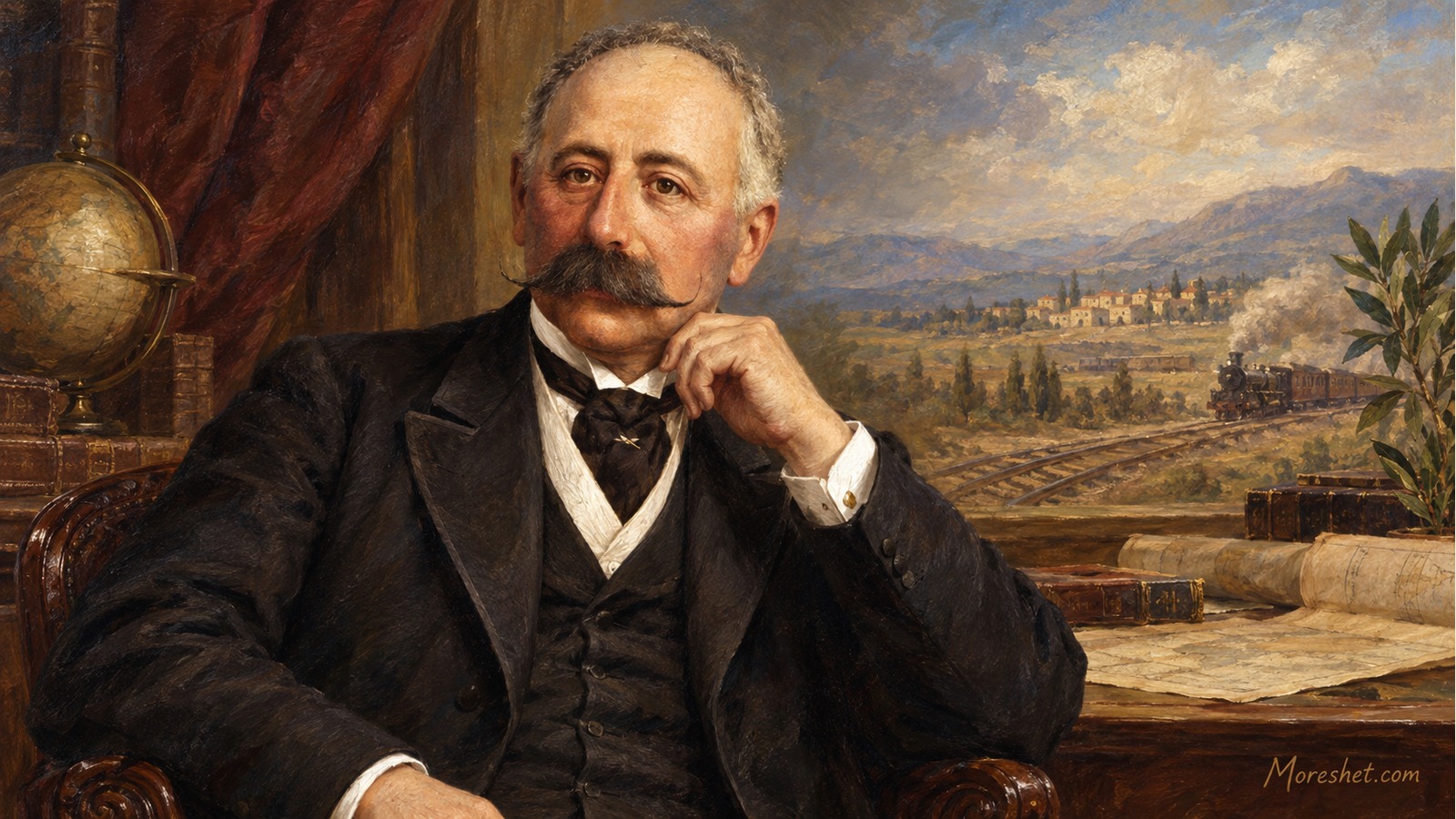
Baron Moritz de Hirsch auf Gereuth — AI-generated artistic portrait · Moreshet.com
Wealth, responsibility, and new horizons for Eastern European Jews
Baron Moritz de Hirsch auf Gereuth, also known as Moses Hirsch (December 9, 1831–April 21, 1896), was a German-Jewish financier and philanthropist who lived and worked in France, England, and the Austro-Hungarian Empire. He devoted substantial resources to improving Jewish lives and creating practical opportunities for communities facing poverty, insecurity, and limited economic prospects. Through the Jewish Colonization Association, known as ICA, which he established, Hirsch helped organize and finance the mass migration of Eastern European Jews to the Americas, particularly to the Baron Hirsch settlements in Argentina.
From private wealth to a far-reaching Jewish enterprise
Hirsch’s importance lay not only in the scale of his fortune but also in the way he sought to use it. Rather than limiting his philanthropy to isolated gifts, he supported an organized undertaking intended to help Jews begin new lives in places where they could work, support themselves, and establish communities. ICA provided a central framework for this effort, combining planning with significant financial support.
The activity associated with Hirsch formed part of the mass migration of Eastern European Jews to the Americas in the late nineteenth century. For many migrants, the move to Argentina and to settlements established through his initiative meant more than a change of location. It was an attempt to create the foundations of economic and communal life under new conditions. In this way, Hirsch affected immigrants, Jewish families, and the development of Jewish communities beyond Europe.
A meeting with Theodor Herzl
Hirsch’s meeting with Theodor Herzl in 1895 opened an important stage in Herzl’s activity on behalf of Zionism. The encounter links two major dimensions of modern Jewish history: practical efforts to improve Jewish life through migration and settlement, and the emerging vision of Jewish national renewal. Although Hirsch and Herzl pursued different paths, Hirsch’s work offered a notable example of how wealth, organization, and public responsibility could be mobilized in response to large-scale Jewish hardship.
Personal loss and a wider idea of inheritance
In 1887, Hirsch lost his only son, Lucien, who died at the age of thirty-one from a lung ailment. After his son’s death, Hirsch said: I have lost my son, but not my heirs. My Jewish brothers and all of humanity will be my heirs. The statement expresses the way he understood his responsibility: not simply as the accumulation or inheritance of wealth, but as the use of resources for a broad public and for humanity as a whole.
Why this legacy belongs in Moreshet
Baron Moritz de Hirsch merits inclusion in Moreshet because his philanthropy had a practical and lasting effect on Jewish life during a period of profound change. The creation of ICA, his support for the migration of Eastern European Jews, and his backing of Jewish settlement in Argentina transformed philanthropy into an undertaking that reached families and entire communities rather than only individual recipients. His meeting with Theodor Herzl also gives his life a place in the history of modern Jewish thought and action. For Moreshet, he represents a form of Jewish leadership that joined personal responsibility, organized initiative, and confidence in the future. His place on Moreshet.com is equally significant because his legacy illuminates the history of migration, settlement, and Jewish communal life beyond Europe.