Ariel Sharon
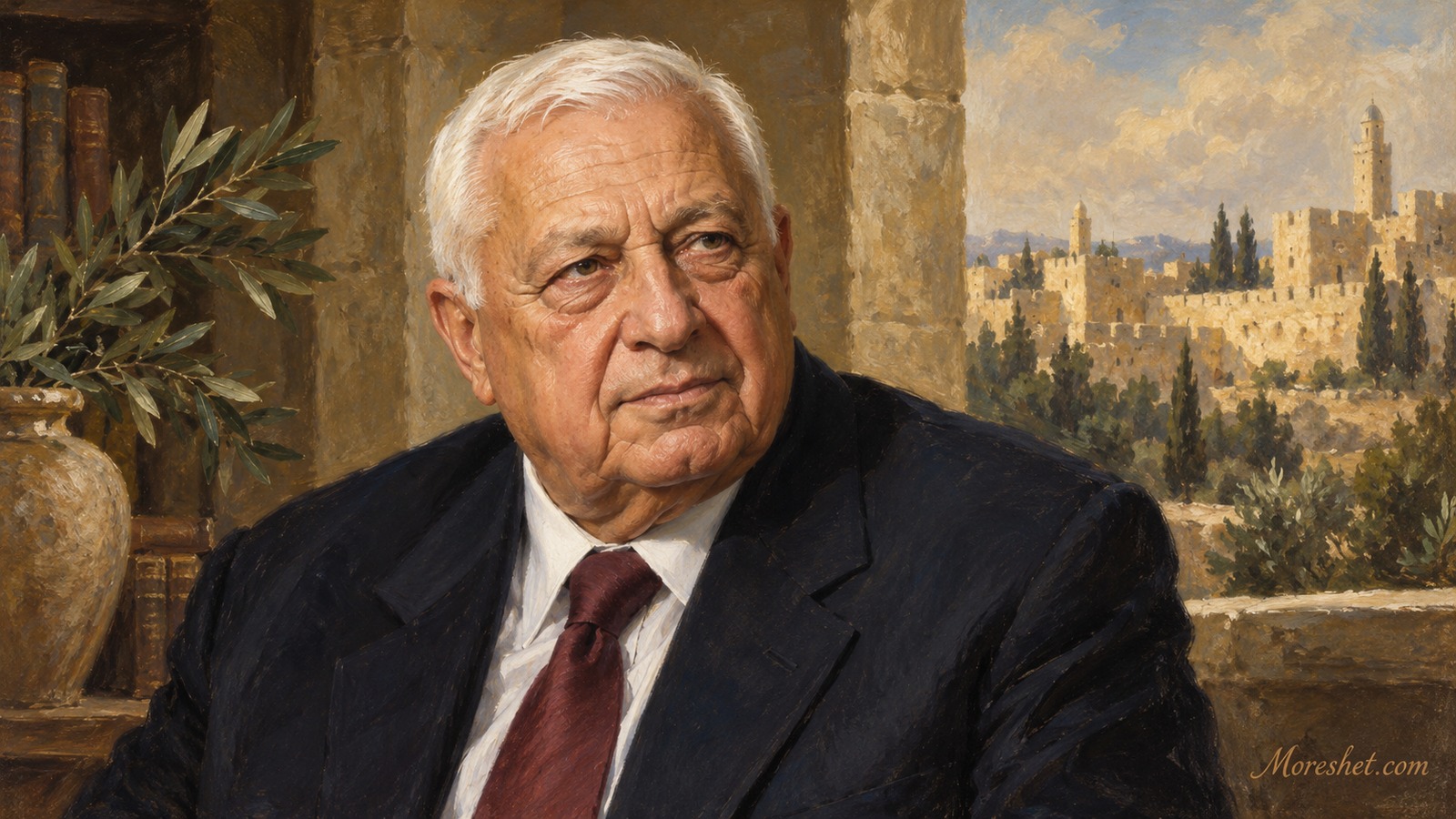
Ariel Sharon — AI-generated artistic portrait · Moreshet.com
Israel’s 11th Prime Minister, IDF major general, founder of Unit 101, senior commander in Israel’s wars, co-founder of Likud, Defense Minister, Foreign Minister and a leader who reshaped Israeli security, settlement and politics
Ariel Sharon, born Ariel Scheinerman and widely known as Arik, was an Israeli soldier and statesman, the 11th Prime Minister of Israel and one of the most consequential figures in the country’s history. Before entering politics, he was one of the Israel Defense Forces’ most prominent field commanders: founder of Unit 101, commander of the paratroopers, division commander in the Six-Day War, commander of Southern Command, and commander of Reserve Armored Division 143, which crossed the Suez Canal in the Yom Kippur War. He later became a co-founder of Likud, Minister of Agriculture, Minister of Defense, Minister of Housing and Construction, Minister of National Infrastructure, Foreign Minister and Prime Minister from 2001 to 2006.
Few Israelis have inspired the same mixture of admiration, opposition, loyalty, anxiety and controversy. To many, Sharon was an exceptional commander, a man of action and a leader who understood terrain, force and enemy intentions. To others, some of his military and political decisions raised profound questions about the limits of power and responsibility. Historically, however, there is no doubt that Sharon helped shape Israel’s security doctrine, political map, settlement enterprise, response to terrorism, and finally the idea of unilateral withdrawal from the Gaza Strip. His life is the story of an Israel that fights, builds, argues and changes course.
Childhood in Kfar Malal and Zionist roots
Sharon was born on February 26, 1928, in Kfar Malal, a workers’ moshav in the Sharon plain, to Shmuel and Vera, Dvora, Scheinerman. His parents immigrated to the Land of Israel in the early 1920s after fleeing regions of the former Russian Empire and the Caucasus. His father was an agronomist; his mother had studied medicine before migration and circumstance interrupted her studies. The home in which he grew up was shaped by hard labor, independence, stubbornness, agriculture, Hebrew culture, Zionism and a measure of suspicion toward communal and party structures that had not always accepted the family easily.
The young Ariel grew up among fields, orchards and guard duty around the family farm. Early in life he learned that land was not an abstraction but something one plows, plants, guards and pays a price for. The Scheinerman family’s isolation inside Kfar Malal, combined with agricultural labor and local defense responsibility, helped shape his temperament: independent, suspicious of convention, stubborn, physical and willing to act even in the face of resistance.
As a teenager he joined the Gadna youth battalions and later the Haganah. He took part in guard duty, training and local security activity before the establishment of the state. For his generation, the movement from agricultural childhood to security service was not a sharp transition; it was a natural continuation of Jewish life in the Yishuv. Sharon grew up with the understanding that the future Jewish state would be built not only through diplomatic decisions, but also through Hebrew self-defense.
The War of Independence and the wound at Latrun
During Israel’s War of Independence, Sharon served in the Alexandroni Brigade. He commanded a platoon, took part in difficult battles and was seriously wounded in the First Battle of Latrun, during the attempt to open the road to besieged Jerusalem. His wound was severe, and his evacuation from the battlefield became a formative experience. Later, it was linked to his belief that no soldier is left behind, not merely as a slogan but as a military and moral principle.
Latrun gave Sharon an early lesson in the price of error, chaos and imperfect warfare. The young IDF was still learning how to use forces, command, coordinate and turn fighting units into an army. Sharon, who saw the gap between personal courage and organized military competence, carried with him the need for constant improvement in Israel’s fighting power.
After recovering, he continued in service, commanded the Golani reconnaissance unit and served in intelligence roles in Central Command and Northern Command. Already then he stood out as an initiative-driven officer, bold and not always comfortable for his superiors. His career would repeatedly show the same tension: exceptional operational talent, an ability to see opportunity on the battlefield, and at times a tendency to stretch the limits of orders.
Unit 101 and the birth of Israeli commando spirit
In 1953 Sharon was assigned to establish Unit 101, a small commando force created to carry out reprisal operations against fedayeen attacks and cross-border infiltrations. The unit existed for only a short time, but its influence on the IDF was considerable. It created a pattern of initiative, navigation, raiding, night movement, comradeship, mission focus and carrying the fight into enemy territory.
Unit 101 and the reprisal operations in which it took part remained a source of hard controversy, especially because of harm to civilians in some operations, most notably at Qibya. Yet in terms of IDF force-building, the unit marked a deep change: from a mainly defensive settlement-based posture to a small, sharp, mobile and daring military force capable of responding quickly and restoring deterrence. Sharon played a decisive role in shaping that spirit.
After Unit 101 was merged with the 890th Paratroopers Battalion and later into the Paratroopers Brigade, Sharon continued to lead reprisal operations. Under his command, the paratroopers became one of the symbols of the young IDF: an offensive fighting force seeking to restore Israel’s sense of initiative and security in its early years.
The Suez Campaign and the Battle of Mitla
In the 1956 Suez Campaign, Sharon commanded the Paratroopers Brigade. The force was dropped and moved through Sinai as part of the campaign against Egypt. The battle at the Mitla Pass became one of the events most closely associated with his military path: on one hand, the paratroopers showed courage and high combat ability; on the other, the battle exacted a heavy price and raised criticism regarding command decisions, operational necessity and adherence to instructions from higher command.
Mitla already showed the tension that would accompany Sharon throughout his life: a field commander of extraordinary daring, but also a figure whose actions could generate controversy inside and outside the army. For several years afterward, his promotion was delayed. He filled training and command positions, studied law and continued developing his ideas about maneuver, initiative, night combat and battlefield decision.
Despite the criticism, his influence on infantry and special forces continued. He helped make tactical command in the IDF more professional, more offensive and more aware of the importance of surprise, terrain and the independence of subordinate commanders.
The Six-Day War and the Battle of Abu-Ageila
During the Six-Day War, Sharon commanded Division 38 on the southern front. The battle at Umm Katef and Abu-Ageila is still regarded as one of the most carefully planned and successful battles in IDF history. Sharon combined armor, infantry, paratroopers, artillery, engineering and a night assault to create a multi-part operation that broke the fortified Egyptian system.
The battle became a prime example of Israeli maneuver: not merely a frontal assault, but a combination of deception, attack from several directions, exploitation of weak points, effective use of small forces and understanding of the entire enemy system. Sharon’s success in Sinai strengthened his standing as a field commander of the first order, capable of planning and executing a complex operation under pressure.
After the Six-Day War, as Israel found itself in control of new territories, Sharon continued to support a security concept based on depth, settlement, control of movement routes and military initiative. He saw territory not only as a diplomatic map, but as a living space of security, movement, observation and settlement.
Southern Command, the Gaza Strip and the War of Attrition
In 1969 Sharon became commander of Southern Command. During this period he dealt with the War of Attrition against Egypt and growing terrorism in the Gaza Strip. Sharon favored offensive action, maneuver, field intelligence and disruption of enemy routine. He opposed excessive reliance on the Bar-Lev Line as a static chain of strongpoints, preferring a more dynamic concept of defense and maneuver.
In the Gaza Strip he led a harsh campaign against terrorist infrastructure. He used regular and special forces, developed methods for fighting cells, and combined operational pressure, intelligence, field presence and civil control. His actions in the Strip brought a significant reduction in terrorism for years, but also included severe measures toward the civilian population, evacuation and demolitions that drew criticism.
This chapter is important for understanding Sharon both as a commander and as a future statesman. He believed that terrorism was defeated on the ground, by commanders who knew the alleys, camps, villages and population, not only by political declarations. That approach would return during his premiership in the Second Intifada.
The Yom Kippur War and the crossing of the canal
In July 1973 Sharon retired from the regular army, but when the Yom Kippur War broke out he was called to command Reserve Armored Division 143 on the southern front. In the first days of the war the IDF faced a severe situation against the Egyptian crossing, the collapse of confidence and major command gaps. Sharon, who had long warned against weaknesses in the Bar-Lev Line, searched for an opportunity to reverse the campaign.
The central move associated with him was the crossing of the Suez Canal in Operation Abirey Lev. His division broke into the seam between the Egyptian armies, helped create a bridgehead west of the canal and moved the fighting onto Egyptian soil. The move contributed to changing the balance of the war on the southern front and to the encirclement of the Egyptian Third Army. The photograph of Sharon wearing a head bandage near the canal became one of the war’s strongest symbols.
Here too, sharp friction developed between Sharon and other commanders, part of the generals’ war that followed the fighting. Historically, however, the canal crossing is considered one of the decisive IDF moves in the Yom Kippur War, and Sharon became fixed in Israeli memory as one of that war’s outstanding field commanders.
The founding of Likud and the turn to politics
Even before the Yom Kippur War, Sharon worked to create a broad right-wing political bloc. In 1973 he was among the founders of Likud, created from Herut, the Liberal Party and other elements. Soon after the war he was elected to the Knesset, but resigned after a short period in order to retain a military emergency command. It was already clear that Sharon was not merely a former general; he wanted to influence the direction of the state.
After Likud’s victory in 1977, Sharon became Minister of Agriculture in Menachem Begin’s government. In that role he became one of the central forces behind the establishment of communities in Judea and Samaria, the Gaza Strip, the Jordan Valley and the Galilee. To supporters he was a builder of the land and a defender of Jewish presence; to critics he was the political architect of a settlement enterprise that complicated Israel diplomatically and militarily.
Sharon saw settlement as both Zionist and security policy. In his eyes it was a way to create facts on the ground, shape future borders, protect frontier areas and realize the vision of the Land of Israel. This view made him a central figure in the Israeli right for three decades.
Defense Minister and the First Lebanon War
In 1981 Sharon was appointed Minister of Defense. Early in his term he was also responsible for the evacuation of the Yamit settlements as part of completing the peace treaty with Egypt. This already revealed one of the paradoxes that would accompany him: the man who pushed settlement was also required to evacuate Jewish communities when state policy demanded it.
In 1982, as Defense Minister, he led the First Lebanon War, which began as Operation Peace for Galilee against PLO infrastructure in Lebanon. The war expanded its objectives and reached Beirut. It removed the PLO leadership from Lebanon, but also became entangled in prolonged presence, casualties, deep public controversy and difficult questions about the goals and conduct of the war.
After the Sabra and Shatila massacre, carried out by Christian Phalangist forces in the Palestinian refugee camps in Beirut, Israel established the Kahan Commission. The commission found that Israel had not been directly involved in the massacre, but placed personal responsibility on Sharon for not giving sufficient weight to the danger of bloodshed and revenge. Following the commission’s conclusions, Sharon ended his term as Defense Minister and remained in the government as minister without portfolio. This chapter remains one of the hardest and most significant junctions in his biography and in the Israeli debate over military and political responsibility.
Years in government: trade, housing, infrastructure and foreign affairs
After leaving the Defense Ministry, Sharon did not disappear from politics. He continued to serve in Israeli governments in several roles, including Minister of Trade and Industry, Minister of Housing and Construction, Minister of National Infrastructure and Foreign Minister. During these years he rebuilt his public strength, competed inside Likud and continued to influence settlement, economic and infrastructure policy.
As Housing and Construction Minister in the early 1990s, he led large-scale building during the mass immigration from the former Soviet Union. His ministry promoted neighborhoods, caravan sites and many apartments in a short period. The policy also drew criticism regarding management, cost and state commitments, but it contributed to a rapid response to one of Israel’s greatest demographic challenges: absorbing hundreds of thousands of new immigrants.
As Infrastructure Minister and Foreign Minister he also dealt with water, energy, regional relations and international ties. In the late 1990s, after Benjamin Netanyahu lost power, Sharon was elected chairman of Likud and leader of the opposition. He reached the party leadership as a veteran, experienced and familiar figure, but one whom many saw as belonging to the past. Within a short time it became clear that he was about to return to the center of Israeli history.
Prime Minister during the Second Intifada
In 2001 Sharon was elected Prime Minister of Israel after defeating Ehud Barak in a direct election. He entered office during the Second Intifada, when Israel was experiencing a severe wave of suicide bombings, shootings, terrorism and daily insecurity. Sharon formed a broad unity government and sought to present the fight against terrorism as a national mission crossing political camps.
In March 2002, after the Passover bombing at the Park Hotel and a wave of deadly attacks, his government launched Operation Defensive Shield. The IDF entered Palestinian cities in the West Bank and acted to dismantle terrorist infrastructure. The operation, together with further actions, intelligence cooperation, targeted killings and the construction of the separation barrier, later contributed to a substantial reduction in attacks.
His first period as Prime Minister combined a difficult security struggle, international pressure, close relations with the administration of George W. Bush, economic crisis and later recovery. Sharon, who had promised Israelis peace and security, worked above all to restore personal security and erode terrorist capabilities. Within Israeli society his image as a person capable of using force when the state felt under attack became powerful again.
The separation barrier and a changed security concept
One of the central measures of Sharon’s premiership was the advancement of the separation barrier between Israel and parts of the West Bank. For Sharon, who had supported territorial continuity and the idea of the whole Land of Israel for years, agreeing to a long physical barrier was a deep change. It expressed the recognition that protecting civilian life could require practical separation, even if it was not a full political solution.
The barrier generated debate in Israel and abroad, both because of its route and because of its impact on Palestinians and communities. In security terms, however, it was part of a broader system that reduced the ability of terrorist cells to reach Israeli cities. Sharon, the man of terrain and open movement, adopted a tool of blocking, fencing and filtering when reality demanded it.
This move shows the character of late Sharon as prime minister. He did not abandon his security outlook, but he was prepared to change means and pay ideological prices when he concluded that Israel’s security required them.
Disengagement and the founding of Kadima
In 2003 Sharon began advancing the idea of unilateral disengagement from the Gaza Strip and four communities in northern Samaria. In 2005 the plan was implemented: all Israeli communities in the Gaza Strip were evacuated and IDF forces left the Strip. For the man long called the father of the settlements, this was a dramatic and deeply disruptive move.
Sharon presented disengagement as a step intended to strengthen Israel, reduce direct friction with a large Palestinian population, improve Israel’s international position and preserve major settlement blocs in the West Bank. Supporters saw it as a bold strategic decision by a leader who understood the limits of force and demography. Opponents, especially on the right, saw it as a breach of trust, the uprooting of communities and a severe blow to the very enterprise Sharon himself had built.
Disengagement tore Likud and the Israeli right apart. In November 2005 Sharon left Likud and founded Kadima, joined by central figures from both Likud and Labor. Kadima was built around his new approach: a security-minded centrist party seeking to shape Israel’s borders through unilateral decisions if no negotiating partner existed. But soon after founding it, Sharon would no longer be able to lead it.
The stroke, years in coma and death
On January 4, 2006, Sharon suffered a severe stroke. His powers were transferred to Ehud Olmert, and he never returned to functional consciousness. For eight years he remained in a comatose state until his death on January 11, 2014. His death closed a long chapter in Israeli history, but politically and historically his premiership had been cut off in the middle of a major move.
The question of what Sharon would have done had he remained in office remains one of the open questions of Israeli politics. Whether he would have continued unilateral moves in the West Bank, shaped different borders, strengthened Kadima as a governing party or changed course again after Hamas’s rise in Gaza — all of these remain speculation.
What is not speculation is the depth of his influence. From the fields of Kfar Malal to the cabinet table, from Latrun to the Suez Canal, from Unit 101 to Kadima, Sharon almost always acted from the belief that leadership means decision, action and taking responsibility even when the price is heavy.
Family, farm and public image
Sharon was first married to Margalit Zimmerman, who was killed in a road accident in 1962, and later to her sister Lily, who remained his wife until her death in 2000. He had three sons, including Gilad and Omri. Sycamore Ranch in the Negev, where he lived and raised sheep and cattle, was inseparable from his public image: a commander and statesman, but also a farmer, a man of land and a large southern home.
The ranch expressed something deep in his identity. Sharon was not an urban leader or a party intellectual. He thought in terms of terrain, hills, routes, borders, water, herds, communities, orchards and roads. Even when acting in the international arena, his political imagination remained strongly tied to the physical map of the land.
His public image was multi-layered: daring fighter, political bulldozer, builder of settlements, evacuator of settlements, prime minister of the war on terrorism, controversial commander and man of the land with dry humor and affection for food, friends and stories of the past. He was engraved in Israeli memory not as a figure free of contradictions, but as one whose contradictions are part of his historical weight.
Why this legacy belongs in Moreshet
Ariel Sharon merits inclusion in Moreshet because his life crosses almost every foundational station of the State of Israel: the working settlement movement, the Haganah, the War of Independence, the building of the IDF, reprisal operations, the wars of Sinai, Six Days, Attrition and Yom Kippur, the founding of Likud, the settlement enterprise, the Lebanon War, immigrant absorption, the struggle of the Second Intifada, the separation barrier, disengagement and the founding of Kadima. He was not only a witness to history, but one of its practical makers.
Moreshet.com documents Sharon because Jewish and Israeli heritage also includes leaders who defended, built, erred, decided and changed the direction of the state in moments of crisis. Ariel Sharon’s place in Moreshet rests on his immense influence on the IDF, Israeli security doctrine, Israeli politics, the boundaries of the right, settlement policy and the continuing question of how the Jewish state defends itself, holds land, and decides when to fight, when to build and when to withdraw.